
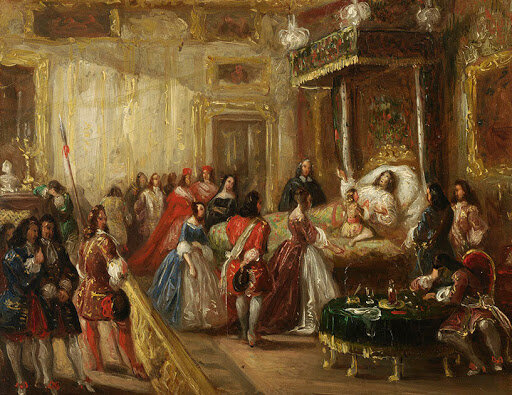
A delightful decorative fabric suspended above the bed creates a wonderful sense of intimacy. Adults appreciate its elegance, and children adore its magic. Bed canopies have become a staple in many homes, but do you know their history? From peasant cottages to the palaces of the Sun King, discover the surprising story of this interior decoration, originally created for practical rather than aesthetic reasons.
The Origins:
It all began in the heart of the Middle Ages in Europe , when a hygiene problem affected the peasants of every developing European country: France, England, Italy, Spain, and Germany.
These peasants mostly slept on the bare ground on pallets covered with straw. Dead insects of all kinds and bird droppings often fell on them. Indeed, their houses were built with poor-quality materials, with thatched roofs that were often badly maintained. Birds and spiders settled in without any qualms. The solution was to spread a large piece of fabric overhead for protection.
Appropriation of the Lordship:
Among the nobility, the problem was minimal or nonexistent . Most lived in castles , manor houses , or large townhouses, which were regularly cleaned by servants. Furthermore, their construction—using wood or stone for the frame and clay tiles for the roof—greatly prevented things from falling to the ground, unlike thatch .
However, upon discovering this method, some decorators saw it as a practical way to create intimacy . Indeed, in the early days of the European castle, the lord and his family slept in the great hall, along with all their servants (the court) . The noble family’s bed was usually located at the far end of the hall and was separated from the others by large, rather cumbersome curtains .
Over time, castle builders made separate rooms for the nobility, but although lords and ladies had their beds to themselves, servants could still share the room with them, as much for reasons of convenience as for security.
But as the privacy of the homeowners became increasingly important, their bed was completely redesigned . Wooden columns forming a frame were installed at the ends to hold thick, brightly colored curtains with patterns .
Therefore, they were no longer hung from the ceiling, but directly on the bed. Furthermore, the entire structure was easily dismantled and transported for travel, when the lord toured his estates. This is how the four-poster bed came to be .
Now a luxury decoration
During the reign of Louis XIV , the Kingdom of France was the most powerful and richest of kingdoms . Eager to express this wealth through every place and moment of his life, the Sun King commissioned the development of the traditional four-poster bed .
He transformed it into a sumptuous, high-quality decorative object, completely concealing the king during the night and protecting him from the cold during harsh weather. The bed canopy now embodies French luxury and royal style .
This spread rapidly throughout the European courts . And just like clothing, home furnishings, or customs, the bourgeoisie would hasten to imitate it in turn .
It was during this era of glory and apogee that the term ” luxury ” as we know it today was born.
Luxury, which was relegated to the shadows during the Revolution , then democratized with the industrial era , exploded after the Second World War with the birth of prestigious fashion houses like Christian Dior , Chanel , and Balmain . Most of these were subsequently acquired by large groups such as LVMH , Richemont , and Kering .
Nowadays
Today, the bed canopy has transformed into a simple draped fabric with a dome , either neutral or colored, sometimes themed, easily hung from the ceiling with a hook. See how to install a bed canopy in 5 steps . It has become much less luxurious and its design has become entirely industrialized .
Its size and style have also evolved into different forms to suit various bedroom needs: babies, children, and adults. Some high-income households reject this type of ornamentation in favor of the four-poster bed , which has retained its “royal essence”.