
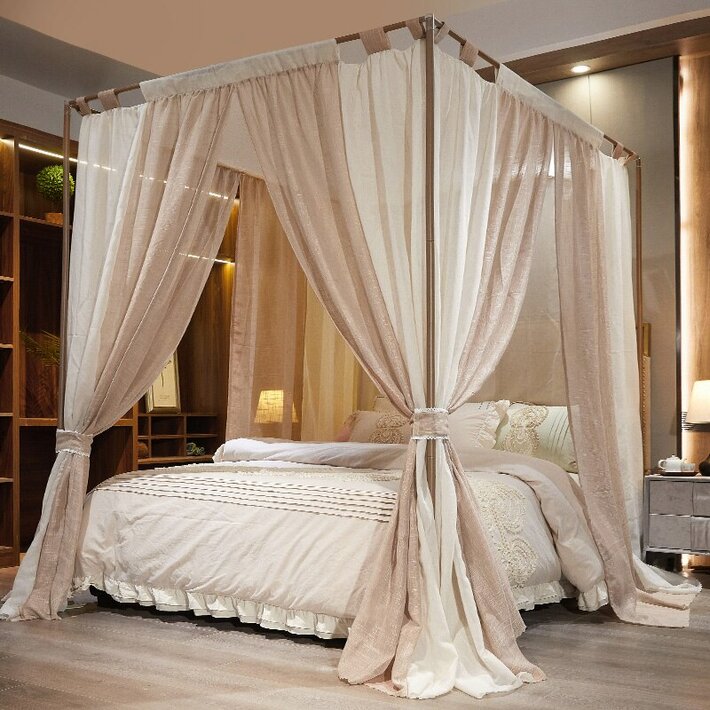
A veritable throne in the bedroom of kings, the four-poster bed is an iconic piece of interior design that has reinvented itself throughout the centuries. Initially designed for practical reasons, it was subsequently completely transformed to adapt to the socio-political needs of different countries. Its history is fascinating, as it comprises not only major historical events, but also carnal and destructive passions. You will never see this decoration in the same way again after discovering the fabulous history of the four-poster bed!
Peasantry
It all began in the heart of the Middle Ages when French peasants had the ingenious idea of suspending a large piece of fabric above their straw mattresses to trap spiders, dust, and other pests that might fall on them. The benefit was therefore practical, allowing for peaceful nights.
Some time later, lords traveling through the countryside noticed that this protective technique was quite widespread. Not having the same unsanitary conditions as the peasantry, they nevertheless decided to install a large cloth draped over their beds, but for reasons of privacy. Indeed, in the 15th century, lords, masters, and servants all slept in the same room.
Lordship
At that time, travel and extended stays were booming. And lords, traveling extensively for political and diplomatic reasons, had to develop methods of rapid packing for increasingly efficient moves. The large piece of fabric hung from the ceiling eventually evolved into an embroidered drape suspended around the bed, thanks to easily dismantled wooden columns.
With this new bedroom design, lords and their families were protected from the cold and, more importantly, separated from the servants’ quarters. Marriages could now be consummated discreetly, eliminating the social stress caused by the visible anticipation of the couple. This imposing protective bed then became known as a four-poster bed.
Monarchy
Then came the Renaissance , an age of artistic and cultural renewal. The various monarchies of Europe saw in the four-poster bed a magnificent way to express their power and wealth. In the 16th century, the four-poster bed thus acquired its prestige and became an object of honor in which kings paraded, and where many heirs were conceived. During this period, beauty and aesthetics were paramount. The woodwork and the choice of fabrics were therefore primarily driven by aesthetic criteria. Only precious woods were used in construction. The columns became veritable sculpted decorations. And the fabrics were carefully selected, adorned with rich tapestries that magnified the royal family’s coat of arms.
Bourgeoisie
Then, around the 17th century, the four-poster bed became more or less widespread. It became a common piece of furniture in all bourgeois social circles. Its use then served social functions and less and less practical ones.
It’s worth noting that at this time, the bed was considered a piece of ceremonial furniture. In wealthier circles, men and women slept in a small bed and received guests only on special occasions in their four-poster beds. However, in less affluent social classes, sleep was a communal activity. Beds were shared by several people, which explains their considerable size. You can see this social reality in Roald Dahl’s literary and cinematic work, Charlie and the Chocolate Factory.
During the French Revolution , amidst various political upheavals and industrialization, the four-poster bed gradually fell out of favor. This was largely due to improved insulation in homes during the 18th and early 19th centuries. But today, it has made a strong comeback in versions adapted to our contemporary lifestyles.
Consumer item
Now primarily serving an aesthetic purpose, the four-poster bed has evolved into various forms: with or without a canopy , with or without a frame, or simply as a frame. While it is still sold in its original version in antique shops and other specialized boutiques, it has primarily developed in contemporary styles and designs with a very clean, minimalist aesthetic. It is also highly prized in bedrooms with a bohemian feel, where wood is omnipresent, often with a rocking chair near the window.
While typically suited to larger bedrooms due to its bulky structure, it can also work in a smaller room. In such cases, it should be particularly simple and fitted with light curtains, or even without curtains at all. However, this issue has become less of a problem thanks to models consisting solely of a canopy and an easily disassembled frame, primarily made of metal. Our shop has chosen to offer only models of this type.
The four-poster bed is therefore well and truly back! To offer you ever greater physical and visual comfort.
So what are you waiting for to make this legendary bedroom item your own?